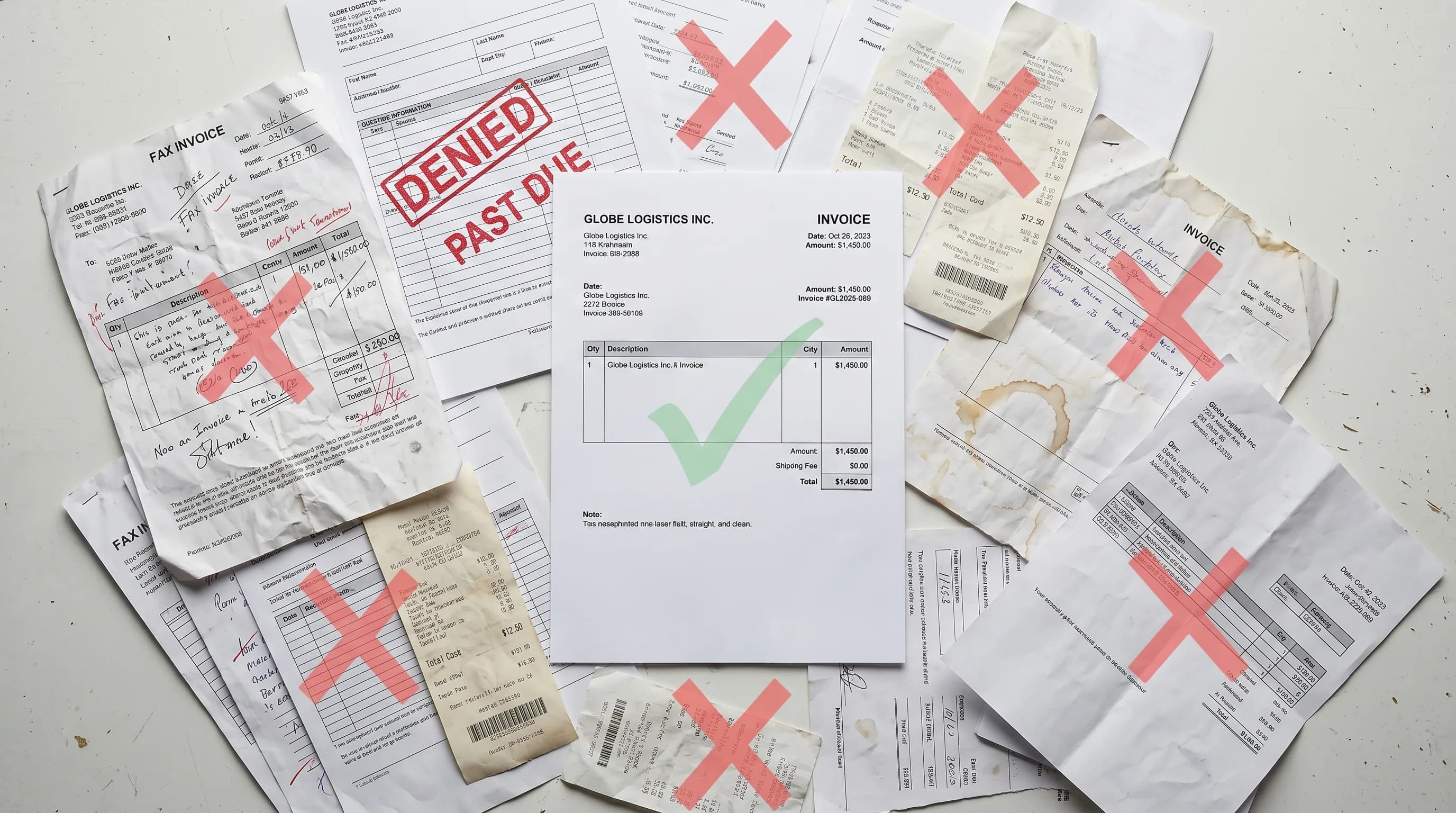
Off-the-shelf OCR engines demo beautifully on a clean invoice and collapse on the documents that actually arrive: a scanned bank statement from a regional branch, skewed, stamped, two columns on one page and three on the next, with a handwritten note in the margin. The engine still returns text. It just returns the wrong text, confidently, with no signal that anything went wrong. That last part is what costs you in production.
The engine returns the wrong text confidently, with no signal that anything went wrong. That silence is what you are actually paying to fix.
The demo set is a lie your vendor tells by accident
Public OCR benchmarks are mostly typed, single-column, high-DPI pages. Real intake is heterogeneous: dozens of layouts from different issuers, varying scan quality, rotated and overlapping content, tables whose column boundaries the engine cannot see. Raw character accuracy of 98% sounds excellent until you do the arithmetic. A statement with 400 numeric fields at 98% per-character accuracy has, in practice, several wrong values per page, and a single transposed digit in an account balance is not a rounding error, it is a defect that flows downstream into whatever consumes it.
In a government engagement parsing heterogeneous bank statements, the OCR engine was never the hard part. The hard part was that no two issuers agreed on layout, and the same issuer changed format across years. The value was never in the model. It was in everything wrapped around it.
The pipeline is the product
Treat OCR as one stage that emits noisy candidates, not as the system. Four stages around it do the real work.
- Format-aware parsing. Classify the document and route to a layout-specific extractor before reading values. A statement is not free text; it is a known structure with named regions. Detect the issuer and template first, then parse against that template's geometry rather than running one generic reader over everything.
- Validation and reconciliation. Encode what must be true and check it. Debits plus credits must reconcile to the closing balance. Dates must fall in the statement period. Account numbers must pass a checksum. Most extraction errors are caught here for free, because a wrong digit breaks an arithmetic identity the document itself guarantees.
- Confidence thresholds. Keep the engine's per-field confidence and combine it with whether the field passed validation. High confidence plus a passing check auto-commits. Anything else is a candidate for review.
- Human-in-the-loop on the fields that failed, not the documents. Route individual low-confidence or failed-validation fields to a reviewer with the cropped image beside the extracted value. You are not re-keying pages, you are adjudicating exceptions.
One decision rule
Auto-commit a field only when OCR confidence clears your threshold and every validation rule it participates in passes. If either fails, it goes to a human. Tune the threshold against a labelled set so your false-accept rate hits the level the business can tolerate, and let validation, not raw confidence, carry most of the weight. Confidence scores are miscalibrated across layouts; arithmetic identities are not.
Implementation notes
We fine-tuned the OCR step on the actual document population rather than relying on a generic model, which materially cut the exception rate on the noisy issuers. Orchestration ran on Airflow so each stage was independently retryable and observable, extraction served behind FastAPI, structured output landed in PostgreSQL with both the committed value and the raw candidate plus confidence retained per field. Keeping the raw candidate matters: it makes every auto-commit auditable and gives you the labelled data to retrain the next iteration.
Log the validation outcome per field, not just per document. Your most valuable artefact is the running record of which rules fire most often, because that tells you exactly where the next layout-specific extractor will pay for itself.
Size the review queue like a production line
The exception rate is your real capacity plan. If 8% of fields fail validation or confidence on a given issuer, and a reviewer adjudicates a few hundred fields an hour with the cropped image beside the value, you can compute reviewer headcount per thousand documents before go-live instead of discovering it as a backlog in week two. The economics then improve on their own: every adjudicated exception is a labelled example, the retrained extractor cuts the exception rate on exactly the layouts that generate the most work, and the queue shrinks quarter by quarter. Run it the other way, with review staffing as an afterthought, and the exception queue silently becomes the new manual process you were trying to retire. Retaining raw candidates buys one more thing: engine portability. Because every committed value stores the candidate and confidence it came from, swapping or upgrading the OCR engine is a re-run and a diff against known outcomes, not a leap of faith, which keeps the vendor decision reversible for the life of the system, and the pipeline you built as the durable asset it actually is.
What it buys the business
On that engagement, processing a statement went from weeks to roughly one day, with full auditability and no silent errors entering the system of record. The headline number was not OCR accuracy. It was throughput at a defect rate the organisation could defend, because exceptions were surfaced and adjudicated rather than buried. Off-the-shelf OCR wins the demo because the demo never tests the part that matters. Buy the engine if you like. The system you have to build is the pipeline.


